
2028 Chevy Sonic Crossover EV
The automotive world is currently vibrating with a rumor that feels like a fever dream: the Sonic is back. But before you conjure up images of that quirky, budget-friendly hatchback of the mid-2010s, you need to clear your cache.
The 2028 Chevy Sonic Crossover EV isn’t just a rebirth; it’s a total reimagining of what an affordable electric vehicle can be in an era dominated by oversized behemoths.
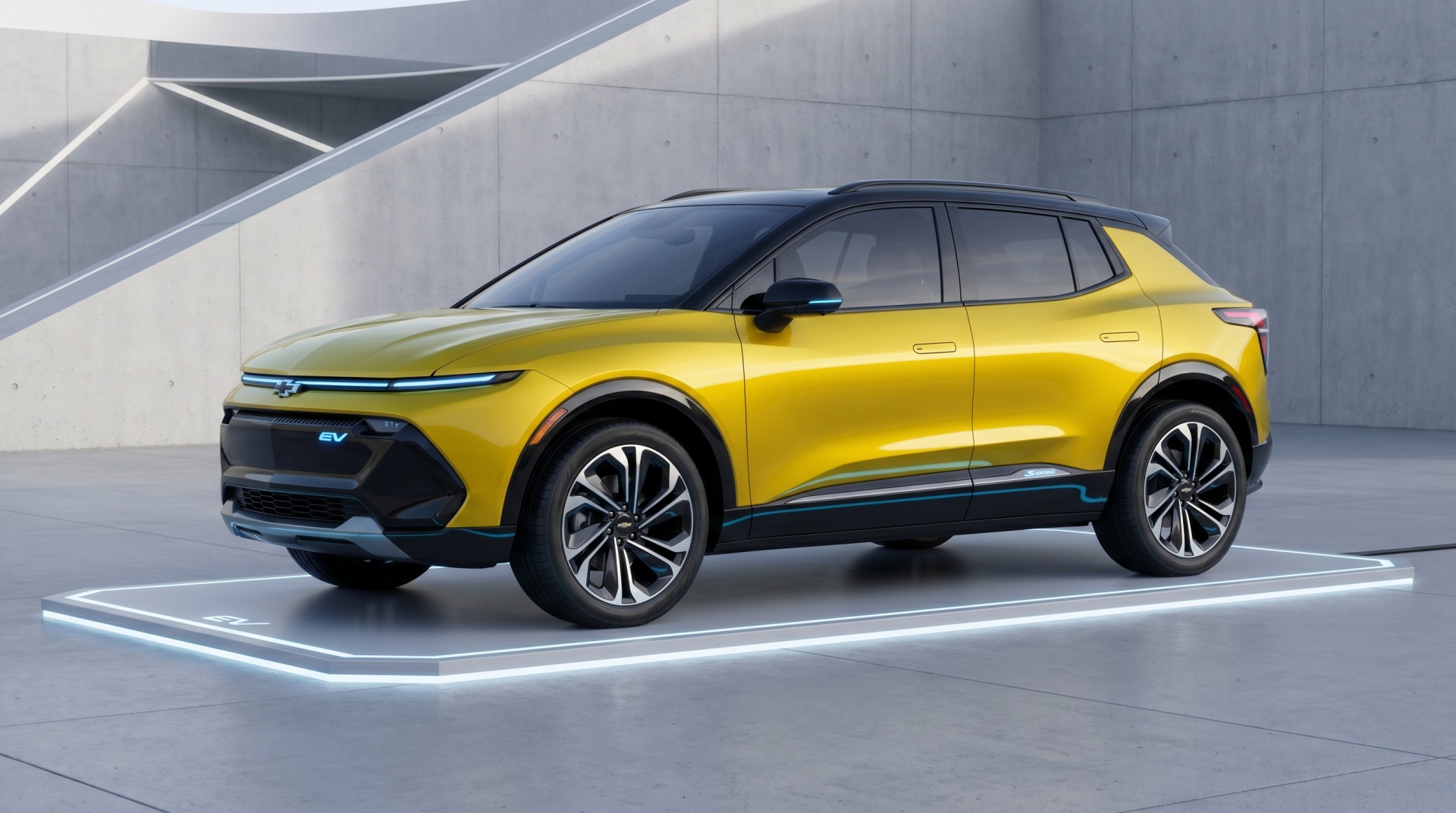
Recent leaks from within the General Motors supply chain suggest that Chevrolet is preparing to drop a bombshell on the electric subcompact SUV segment.
With a combination of Ultium platform efficiency and a surprisingly rugged persona, the new Sonic is positioning itself as the “Swiss Army Knife” of the GM EV lineup.
A Design That Defies Its Ancestry
If the old Sonic was a sensible pair of sneakers, the 2028 Chevy Sonic redesign is a high-tech hiking boot. Forget the dorky proportions of yesteryear.
The leaked renders show a vehicle that borrows heavily from the “Equinox EV Lite” playbook but adds a muscular, flared-fender aesthetic that screams “adventure.”
The 2028 Chevy Sonic Crossover EV sits higher, wider, and looks infinitely more confident. It features a “floating” roofline and a closed-off front grille that utilizes active aero shutters to maximize efficiency.
It’s clear that Chevy is targeting a younger, more active demographic that wants the footprint of a city car but the capability of a compact crossover.
Shocking Range Specs: Breaking the 350-Mile Barrier?
The most “shocking” part of the recent leak involves the EV range. Traditionally, entry-level electric cars have been plagued by the “city-car” curse—limited range that makes long-distance travel a game of Russian Roulette with charging stations.
However, insiders suggest that the 2028 Chevy Sonic Crossover EV will utilize a new generation of Ultium battery technology featuring higher energy density cells.
While the base model is expected to offer a respectable 250 miles, the “Long Range” variant is rumored to hit a staggering 350 miles on a single charge.
If these numbers hold up, the Sonic would effectively obsolete its competition in the affordable EV market.
Achieving this in a subcompact frame requires incredible packaging efficiency, and it seems Chevy has cracked the code by integrating the battery pack more structurally into the chassis, allowing for more cells without sacrificing interior cabin space.
The “Secret” Off-Road Mode: A Small SUV with Big Ambitions
Perhaps the most intriguing part of the leak is the mention of a “Secret” off-road mode. In a segment usually reserved for front-wheel-drive pavement queens, Chevy is reportedly testing an all-wheel drive (AWD) dual-motor configuration for the Sonic.
Sources indicate this mode—internally referred to as “Trail-Runner Mode”—optimizes the instant torque of the electric motors to mimic a locking differential.
By precision-braking individual wheels and managing power delivery, the 2028 Chevy Sonic Crossover EV should be able to handle more than just a dusty gravel driveway.
We’re hearing whispers of a Z71 trim level for the Sonic, which would include:
- Increased ground clearance.
- All-terrain tires wrapped around 18-inch aero-wheels.
- Underbody skid plates to protect the precious Ultium battery pack.
- Specially tuned regenerative braking for steep descents.
This isn’t meant to chase Jeep Wranglers up Moab, but for the weekend camper or the enthusiast who lives in the “snow belt,” this electric subcompact SUV offers a level of utility previously unseen at this price point.
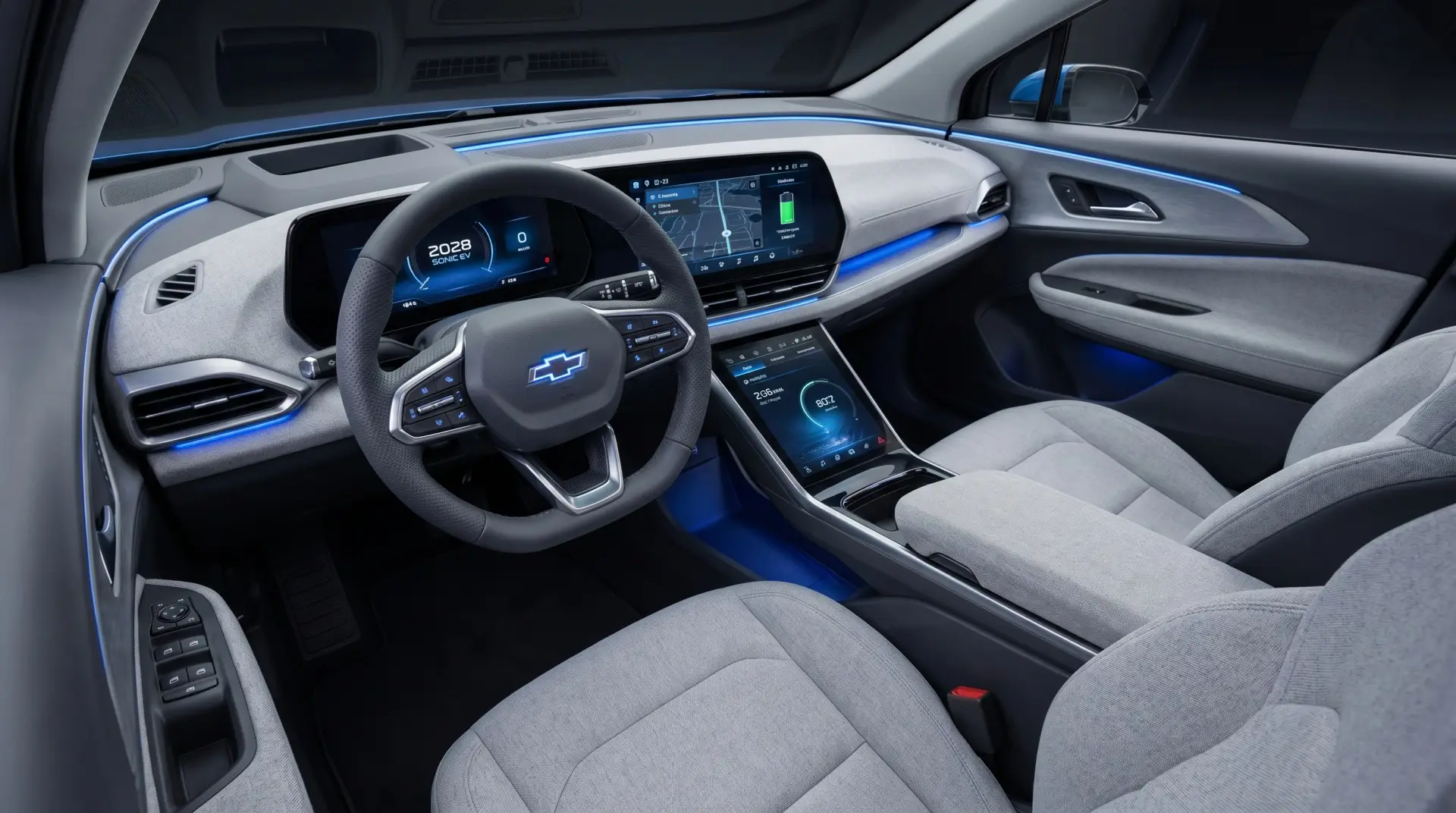
Interior Tech: The Digital Cockpit
Inside, the 2028 Chevy Sonic Crossover EV is expected to ditch the “budget” feel of its predecessor.
Following the trend set by the Blazer EV, the Sonic will likely feature a massive 17.7-inch infotainment touchscreen angled toward the driver.
Expect a heavy emphasis on software-defined vehicle features. The Sonic will likely launch with Google Built-in, offering seamless integration for navigation and media.
More importantly, over-the-air (OTA) updates will allow Chevy to tweak the battery management system and even the “Trail-Runner” software long after the car has left the showroom.
Despite its small footprint, the move to a dedicated EV platform means there’s no transmission tunnel. This creates a flat floor, providing rear-seat legroom that rivals many mid-size sedans. It’s a masterclass in “small on the outside, big on the inside” engineering.
Performance and Fast Charging
While the Sonic isn’t trying to be a Corvette, the electric motor performance won’t be sluggish. The dual-motor AWD version is rumored to produce around 280 horsepower, giving this compact crossover a 0-60 mph time in the low 5-second range.
When it comes to “filling up,” the Sonic will support DC fast charging at speeds up to 190 kW. In plain English? You can add approximately 100 miles of range in 10 minutes.
For a car intended to be a primary driver for many households, this fast charging capability is the bridge that makes EV ownership viable for those without a home charger.
Market Position: The $30,000 Sweet Spot
The real genius of the 2028 Chevy Sonic Crossover EV lies in its projected pricing. Rumors suggest a starting MSRP in the $28,000 to $32,000 range before any federal tax credits.
In an economy where the average new car price has spiraled out of control, a long-range electric SUV that sits under the $30k mark is the “Holy Grail.”
Chevy is leveraging its massive economies of scale with the Ultium project to undercut rivals from Hyundai and Volkswagen, potentially sparking a massive shift in EV market share.
The New Benchmark?
The 2028 Chevy Sonic Crossover EV represents a pivotal moment for Chevrolet. It’s a signal that the “experiment phase” of electric vehicles is over.
By taking a nameplate known for value and injecting it with high-performance EV specs and genuine off-road capability, Chevy is making a loud statement.
If the leaked specs regarding the 350-mile range and the specialized off-road mode are accurate, the Sonic won’t just be a good “small car”—it will be the benchmark for the entire automotive industry. We expect an official reveal late in 2027, with the first units hitting dealerships in early 2028.
For those who have been waiting for an electric vehicle that is practical, affordable, and actually fun to look at, your wait is almost over. The Sonic is back, and this time, it’s playing for keeps.